
Amidst a raging blizzard, Wu Bolin remains unaware that the Pentagon and Japanese Ministry of Defense are secretly strategizing countermeasures against a rebellious Japanese research team. The Pentagon confirms the treason but proposes a diplomatic approach of sending unarmed negotiators, while Japan insists on a forceful military intervention, only to be denied by the Pentagon due to Antarctic Treaty restrictions.
Hero of heart The amazing son in law complete
Chapter 7453
At this time, Wu Bolin was still sitting cross-legged quietly inside the snowmobile.
A blizzard may be raging outside, but his mind is as calm as water. He’s on his way to assist more than 200 researchers at the United States’ McMurdo Station.
However, there was one thing he didn’t realize: the Pentagon and the Japanese Ministry of Defense were holding a top-level secret meeting to discuss countermeasures against the Japanese team’s rebellion.
Wu Bolin is currently still about two days’ travel from McMurdo Station.
In Washington, the Pentagon has confirmed that the Japanese research team in Antarctica has indeed committed treason.
However, the American reaction was tepid. They took no proactive action other than sending a warning to their own research station staff: “Beware of the Japanese.”
On the other hand, the Japanese Ministry of Defense was in a state of panic.
After learning of the confirmed case of treason, they demonstrated a strong determination to resolve the matter as quickly as possible. They feared this disgrace would spread throughout the world.
Counter-Insurgency Plan
After a day of heated discussions between Pentagon and Tokyo officials, the Pentagon chief finally put forward a plan.
In the video conference, the American side said:
“Our idea is simple. The Japanese Ministry of Defense must send a negotiating team. You will fly directly to Antarctica on our specially modified LC-130 Hercules transport aircraft.”
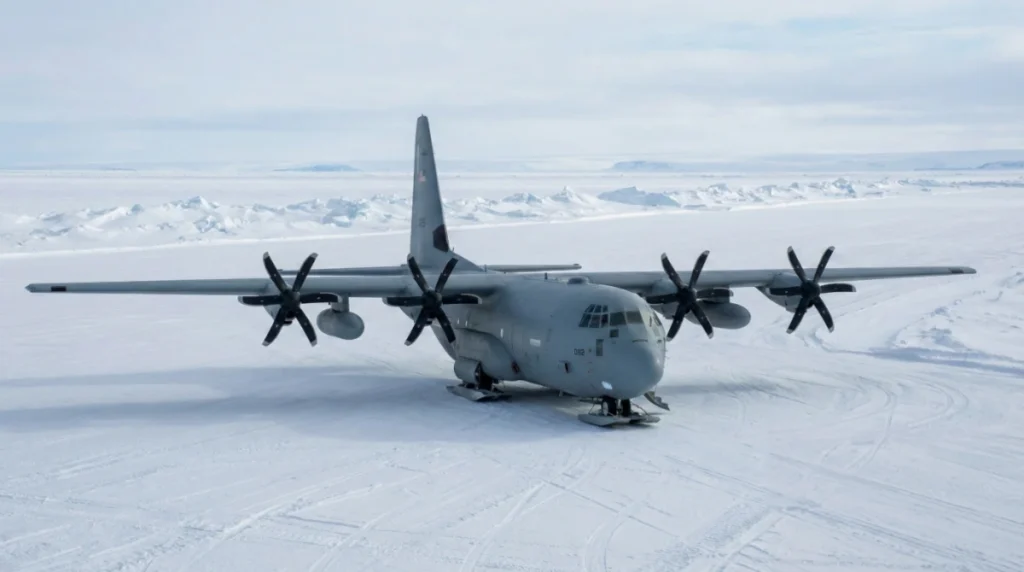
The plan sounds diplomatic.
“Your team will meet with the defectors. Find out the specifics of the situation, then stabilize their emotions through negotiation. Ideally, persuade them to surrender and take them to a US military base for interrogation.”
Upon hearing this “soft” proposal, the head of the Japanese Ministry of Defense was dissatisfied. He considered this method too risky and unreliable.
He interrupted firmly, “In fact, we hope to immediately deploy 100 special forces and six armored infantry vehicles to Antarctica. We want to capture these people and forcibly bring them back to Japan.”
The Pentagon official immediately shook his head.
“That’s impossible,” he flatly denied. “According to the Antarctic Treaty, no country is permitted to conduct military operations there. Even military exercises are strictly prohibited.”
The Japanese official laughed awkwardly, trying to lighten the mood.
“But, Your Majesty… you represent the United States. Isn’t the United States under no obligation to abide by these kinds of agreements?”
The Pentagon chief replied in a cold and firm tone.
“We can’t afford the stigma of conducting military operations in Antarctica. The best solution is for you to send unarmed personnel.”
He added dismissively, “Besides, even if they’re traitors, they’re just scientists. They certainly don’t have any weapons. We don’t need to send elite troops to deal with a bunch of unarmed, bespectacled people.”
The Japanese Ministry of Defense was silent. They were powerless.
The main problem is logistics. With the current extreme weather, few aircraft in the world are capable of landing safely on the Antarctic ice shelf. And unfortunately, Japan doesn’t have that. They are completely at the mercy of America.
For the Americans, this was a disadvantage. Whether the rebellion was suppressed or not was Japan’s business. Sending troops and violating international treaties for the sake of another nation’s problems was foolish in their eyes.
Negotiation Team Flies South
Finally, Japan surrendered.
They had no choice but to send a negotiating team of twenty people: negotiation experts, psychologists, and legal advisors. Their mission was to persuade the defectors to surrender.
The team was immediately flown to a US military base in South America, the last transit point before the South Pole.
After a grueling 20-hour flight, Wu Bolin—elsewhere—was also getting closer to his destination.
At a US military base in South America, the Japanese delegation was led by a high-ranking official named Goro Watanabe.
Goro Watanabe’s secret mission wasn’t just about negotiations. He wanted to persuade the Americans to smuggle Navy SEALs onto the Hercules, just in case the situation worsened.
However, his efforts were in vain.
“I’m sorry, Mr. Watanabe,” the US officer replied flatly. “The Pentagon has made it clear that no armed personnel are to be brought to Antarctica. Even our pilots are forbidden from carrying handguns.”
Watanabe Goro pleaded, “Sir, this is too risky. If negotiations fail, we will have no defense against those traitors.”
The US military official just smiled faintly as he adjusted his sunglasses.
“Mr. Watanabe, not sending a single soldier or a single bullet to Antarctica is a fundamental principle of the US military. We hope you understand.”
He then stood up, signaling the end of the conversation. “The plane will take off in an hour. Please get ready.”
Watanabe Goro walked out with unsteady steps, feeling like a lamb thrown into a wolf’s den.
Preparation on the Runway
On the icy runway, an LC-130 Hercules aircraft is undergoing final inspection. Its landing gear is unique, featuring a combination of tires and skis for landing on ice.
As planned, the aircraft will land on an ice sheet about 50 kilometers from the Japanese research station.
In addition to carrying 20 negotiators, the plane also carried two unarmed civilian snowmobiles. The crew was seen busy pushing the vehicles into the belly of the plane and securing them with safety chains.
Goro Watanabe and his team waited near the tail of the plane, shivering from the cold, waiting for the signal to board.
Meanwhile, thousands of kilometers south, Kohei Kikuchi reports to Wu Bolin.
“Masato, we will arrive at McMurdo Station in three hours.”
“Very good,” Wu Bolin replied curtly. “As long as we can get in smoothly, everything will be fine.”
(Navigation Button: “NEXT PAGE: AMERICAN MILITARY SURPRISE” -> Link to Page 2)
=== PAGE 2 ===
America’s Change of Attitude and the Special Forces Raid
…
The research team at McMurdo Station was already on high alert. They had received intelligence warnings about the Japanese team’s defection.
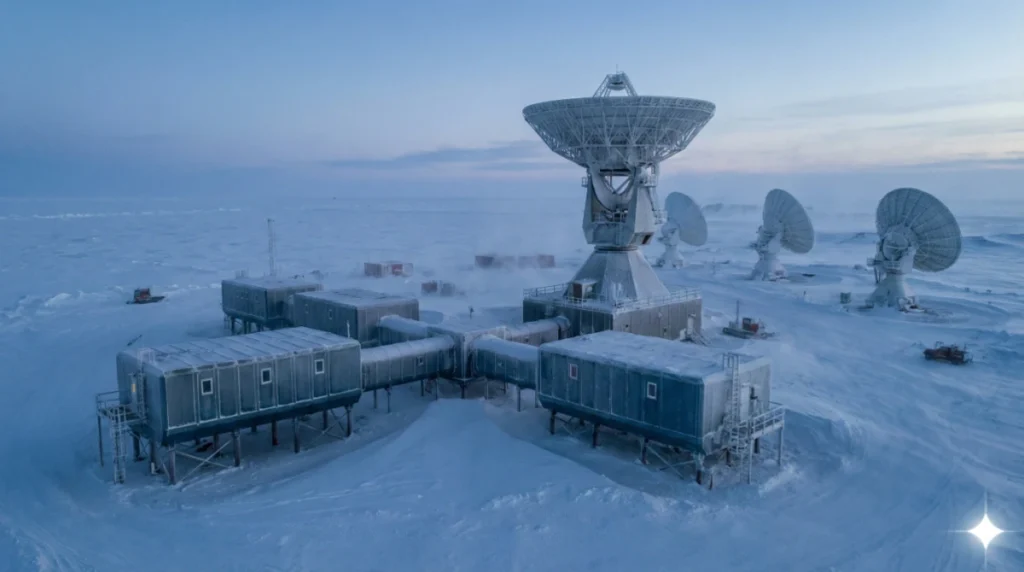
Although the scientists there are civilians, the station is equipped with advanced military technology. Its radar system now operates at maximum power 24 hours a day, scanning for any movement on the silent ice shelf.
When Wu Bolin’s convoy appeared on the radar screen, the alarm immediately sounded.
The radio message was sent in a stern tone: “This is McMurdo Research Station. Approaching vehicles, please state your nationality, number of people, and destination.”
Kohei Kikuchi was shocked beyond belief.
“They detected us from tens of kilometers away?” he muttered in disbelief. “In a snowstorm like this, their radar must be fully operational.”
He immediately turned to Wu Bolin. “Teacher, the Americans are asking for our identities and destination. What should we say?”
Wu Bolin answered calmly, without opening his eyes.
“In this harsh polar region, what is the most plausible reason to contact a stranger?”
Kikuchi thought for a moment. “Asking for help. Everyone in Antarctica usually helps each other.”
“Exactly,” Wu Bolin said. “Tell them we need emergency assistance.”
Kikuchi immediately responded to the radio, claiming to be a member of a Japanese expedition that had experienced vehicle failure and had run out of supplies.
The American researchers at McMurdo are growing increasingly suspicious. The so-called traitorous Japanese team has suddenly come asking for help?
Without wasting any time, they immediately reported this incident directly to the Pentagon.
…
Surprise on the Plane
Back to the air base in South America.
Goro Watanabe and the entire Japanese negotiating team were already seated in the belly of the Hercules aircraft.
The interior of the military aircraft was very spartan. There were no plush seats, just mesh benches along the cabin walls. In the center of the room, two civilian snowmobiles were strapped securely to the floor.
They thought the plane’s doors were about to close. However, a commotion suddenly erupted.
A group of US Air Force personnel rushed into the cabin. Without a word, they untied the two civilian snowmobiles and roughly pushed them out of the plane.
Watanabe gaped. “What are they doing?”
Before he could ask, the next sight made him even more shocked.
Almost a hundred fully armed commandos marched into the plane with heavy steps.
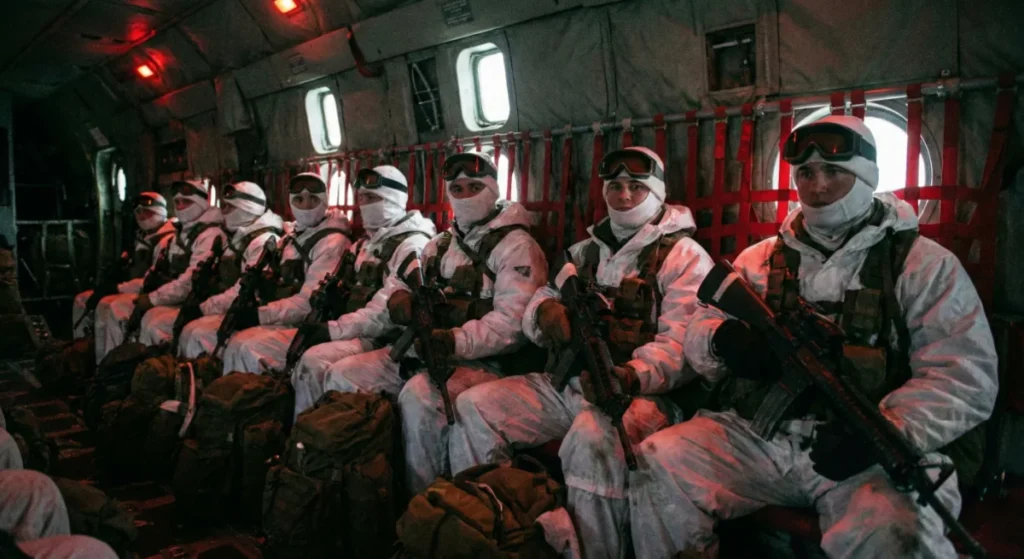
They were dressed in full winter combat gear, with assault rifles slung across their chests. Their faces were covered by ski masks, leaving only their sharp eyes visible.
After the troops entered, the ground crew loaded new cargo: Four armored infantry fighting vehicles!
The atmosphere in the cabin changed drastically from a diplomatic mission to a war mission. The soldiers sat silently with deadly expressions.
Just then, the commander of the US military base stepped onto the plane.
Watanabe Goro immediately stood up and approached him in confusion.
“Commander, what actually happened?” he asked in a trembling voice.
The US polar commander stared at Watanabe with a grim and cold expression.
“We will invade Antarctica!”
Watanabe Goro exclaimed in shock, his eyes widening in disbelief.
“But… didn’t you say you wouldn’t send any soldiers?!”